Reading time:
Last updated:
September 28, 2026
Most conversations about audience data focus on the provider, the coverage, and the price. The choice that usually matters more gets made in a few seconds by whoever is browsing the taxonomy, and it is whether to buy at brand level or category level.
The two look similar in a picker. They behave very differently in a campaign, and picking the wrong one is the most common reason a technically sound segment produces a disappointing result.
WHAT EACH ONE ACTUALLY CONTAINS
A brand-level segment groups devices observed at the locations of a specific named business. A particular supermarket chain, a particular fast food operator, a particular bank.
A category-level segment groups devices observed across a whole class of locations. Supermarkets generally, quick service restaurants generally, bank branches generally.
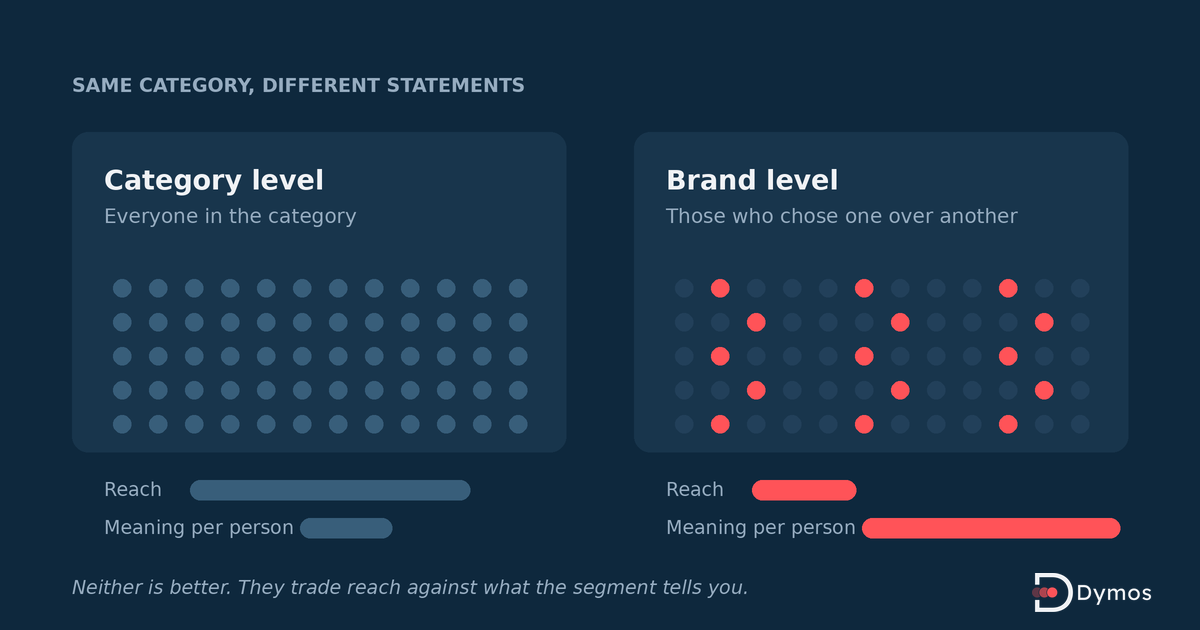
The difference is not just size. A brand segment describes people who chose one business over its competitors, which is a behavioural statement. A category segment describes people who participate in a category at all, which is a much weaker statement about each individual but a much stronger one about reach.
THE TRADE-OFF IN ONE SENTENCE
Brand segments carry more meaning per person and reach fewer people. Category segments reach far more people and carry less meaning about each of them.
Everything else follows from that, including the mistakes.
WHEN BRAND-LEVEL IS THE RIGHT CHOICE
Competitive campaigns are the obvious case. If the goal is to reach people who shop with a competitor, only a brand-level definition expresses that. No category segment can, because the competitor's customers and your own sit inside the same category label.
Loyalty and retention work is the mirror image. Reaching your own customers requires knowing they are yours, which again is a brand-level statement.
Brand also wins where a category contains genuinely different customer bases. Premium and discount grocery are the same category and largely different shoppers. A category segment averages them into a population that resembles neither, and a campaign aimed at either one will waste most of its budget on the other.
And brand-level is the better choice whenever the creative references a specific competitive position. A message built around being cheaper, closer, or better than a named alternative only makes sense to people who use that alternative.
WHEN CATEGORY-LEVEL IS THE RIGHT CHOICE
Market entry is the clearest case. A business new to a market has no customers to retarget and often no meaningful competitive set to conquest, so the sensible target is everyone who participates in the category.
Scale is the second. Brand segments in fragmented markets can be too small to deliver a campaign, particularly in smaller countries or where a brand has limited physical presence. A segment that cannot spend the budget is not a better segment.
Category is also the right input for modelling. Lookalike and expansion models need a broad behavioural base to work from, and a narrow brand segment can produce a model that simply rediscovers the original segment.
And category works well where brand choice is genuinely incidental. People do not form strong allegiances to petrol stations or to cash machines in the way they do to supermarkets, so brand-level precision buys very little.
WHERE CATEGORY SEGMENTS QUIETLY MISLEAD
The risk with category buying is that the label sounds more specific than the behaviour underneath it.
A retail category can contain premium and value operators, destination and convenience formats, weekly shops and emergency top-ups. Someone visiting a convenience format twice a week and someone visiting a hypermarket once a month are both inside the same category, and they are not remotely the same audience.
The practical safeguard is to ask what a category actually contains before buying it. A category definition is a decision someone else made about which businesses belong together, and it may not match how your market works.
MARKET STRUCTURE CHANGES THE ANSWER
This is the part most often overlooked, and it matters particularly in Europe.
Retail concentration differs sharply by country. A market dominated by three or four grocery chains supports brand-level targeting easily, because each brand segment is large enough to deliver a campaign. A fragmented market with many regional operators may not, and the same brand-level strategy that works in one country delivers nothing in the next.
So the brand versus category decision is frequently a market-by-market decision rather than a campaign-level one, and a plan covering several countries may need to be built differently in each.
USING BOTH
The two levels are not alternatives in a well-built plan.
A common structure uses category segments for prospecting and reach, where the objective is to find people in the market at all, and brand segments for the campaigns where competitive position or customer status determines the message.
Combining them in a single definition is also possible and frequently overlooked. Someone who visits a category broadly but has never visited your brand is a prospecting audience with a sharper edge than either segment alone.
HOW TO DECIDE
Three questions usually settle it.
Does the message depend on where someone currently shops? If yes, brand. If no, category is likely sufficient and will deliver more scale.
Is the brand segment large enough to spend the budget in this market? If not, category is the only workable option regardless of preference.
Do the businesses inside the category behave like one audience? If they obviously do not, either buy at brand level or build a narrower category definition.
Frequently asked questions
FREQUENTLY ASKED QUESTIONS
What is a brand-level audience segment?
A segment of devices observed at the locations of one specific named business, which expresses a choice between competitors rather than participation in a category.
What is a category-level audience segment?
A segment of devices observed across a whole class of locations, such as supermarkets or quick service restaurants generally. It reaches more people while saying less about each of them.
Which performs better?
Neither in general. Brand segments carry more meaning and less scale, category segments the reverse. The right choice depends on whether the message depends on where someone currently shops, and on whether the brand segment is large enough to deliver the campaign in that market.
Can brand and category segments be combined?
Yes, and the combination is often stronger than either alone. Category visitors who have not visited a particular brand, for example, form a prospecting audience with a sharper definition than a broad category segment.
Why does the choice vary by country?
Retail concentration differs by market. Where a few chains dominate, brand segments are large enough to deliver campaigns. In fragmented markets they may be too small, which makes category the only practical option even when brand would be preferable.