Reading time:
Last updated:
September 28, 2026
Connected TV has stopped being an emerging channel. Nielsen recorded May 2025 as the point at which streaming viewership overtook combined broadcast and cable reach for the first time, and budgets have followed. Surveys through 2026 consistently show the large majority of CTV advertisers planning to increase spend.
The channel's problem is no longer proving it deserves budget. It is that CTV inherited the scale of television without inheriting any of the infrastructure that made television straightforward to buy.
This guide covers how the channel actually works, where the difficulties genuinely sit, and which of them can be solved with better data rather than more budget.
WHAT CONNECTED TV ACTUALLY IS
Connected TV refers to video advertising delivered to a television through an internet connection, whether that connection runs through a smart TV's built-in operating system, a streaming stick, a games console, or a set-top box.
The category is frequently confused with OTT, which describes the delivery method rather than the screen. The practical distinction that matters to a buyer is whether an impression appeared on a television or on a phone, because the two command very different prices.
Buying happens increasingly through programmatic channels, though published estimates of how much vary widely, from roughly half the market to well over ninety percent depending on the source and on what each counts as programmatic. The direction is not in doubt. The precision of any single figure is.
FRAGMENTATION IS THE DEFINING PROBLEM
Television used to be simple to buy because a small number of broadcasters controlled a small number of channels, and a shared measurement currency told everyone what had been bought.
CTV has none of that. Audiences are spread across dozens of streaming services, several competing device operating systems, and a set of walled gardens that do not share data with each other or with buyers. More than half of advertisers report working with multiple CTV providers simply to assemble reach, and roughly a third name deduplicated reach, cross-provider planning, and walled gardens as their central difficulty.
Three specific consequences follow, and they are worth separating because they have different solutions.
CONSEQUENCE ONE: FREQUENCY BREAKS
This is the most visible failure and the one viewers themselves complain about.
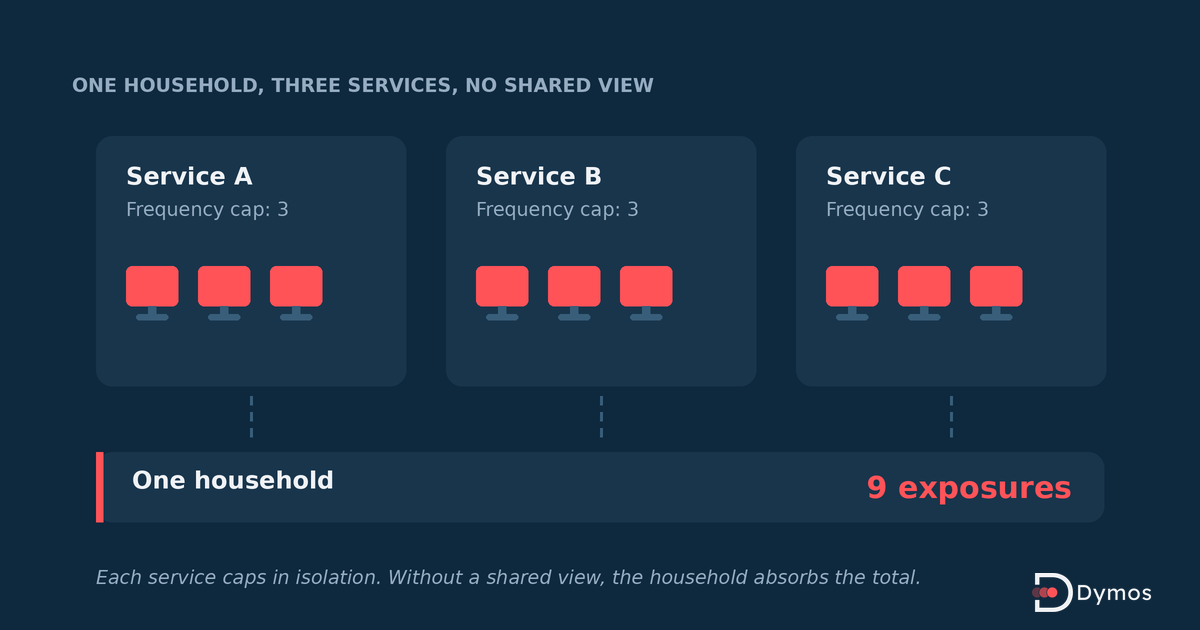
If a household watches three streaming services and an advertiser buys all three without a connective layer between them, each service applies its own frequency cap in isolation. The household sees the same advertisement three times as often as intended. Industry guidance generally places useful exposure somewhere in the range of three to seven times a week, and fragmented buying routinely exceeds that by a wide margin.
The cost is doubled. Budget is wasted on impressions that add nothing, and the viewer's experience of the brand deteriorates precisely because the brand bought more inventory.
Solving it requires recognising the same household across services, which is an identity problem rather than a media-buying one. It is also the clearest argument for household-level signals in CTV, since without some way of connecting exposures across walled gardens, frequency management is guesswork.
CONSEQUENCE TWO: MEASUREMENT HAS NO COMMON CURRENCY
Every platform produces different signals and applies different measurement frameworks, which makes a cohesive cross-platform view difficult to assemble.
Traditional television metrics were not designed for app-based viewing, shared screens, or fragmented platforms, and applying them to CTV produces numbers that look familiar and mean something different. Most advertisers end up assembling a patchwork of marketing mix modelling, incrementality testing, and brand lift studies without unifying them.
Survey work suggests this is the main brake on further investment, with around half of marketing decision-makers saying better ROI measurement would increase their CTV spend, and substantial numbers also asking for better attention metrics and cross-screen effectiveness.
The underlying question most of them want answered is whether CTV results are genuinely incremental or simply correlated with audiences who were going to convert anyway. That is an incrementality question, and it requires a control group rather than a better dashboard.
CONSEQUENCE THREE: TRANSPARENCY AND MISREPRESENTATION
Because most CTV inventory is bought at the app level rather than by channel, buyers often have limited visibility into where an advertisement actually ran.
Industry bodies including IAB Europe's CTV working group have raised device misrepresentation as a growing concern, where inventory is presented as a television impression when it in fact ran on mobile or desktop. Since CTV commands a premium price, misrepresentation is directly expensive.
The practical responses are supply path consolidation, working with fewer and more directly integrated partners, and requesting log-level data so delivery can be examined rather than accepted. Neither is exotic. Both require asking.
WHERE IDENTITY DATA HELPS, AND WHERE IT DOES NOT
Connective identity is the usual answer offered to fragmentation, and it is a genuine part of the solution. It is also frequently oversold, so the boundary is worth stating plainly.
Identity signals can reasonably support recognising a household across services for frequency management, suppressing existing customers from prospecting campaigns, and connecting exposure to a later outcome for measurement.
They cannot establish which member of a household is watching. A television is a shared screen, co-viewing is normal, and no identifier in the impression resolves to a person. Any proposition implying individual-level addressability on a television is describing something the medium does not support.
They are also only as good as the method behind them. Research published by CIMM and Go Addressable in late 2025 found IP addresses matched postal records around thirteen percent of the time, and concluded IP should not be used as the primary method of identifying a household. That does not make household signals useless, but it does mean they belong alongside other evidence rather than underneath everything.
A PRACTICAL PLANNING CHECKLIST
Establish how frequency will be managed across providers before buying any of them, because retrofitting it is considerably harder.
Decide what will count as proof before the campaign runs, and if the answer is incrementality, design the holdout at the start rather than reconstructing one afterwards.
Ask for log-level delivery data and check the device mix, so that television rates are paid for television impressions.
Treat CTV as an addressable digital channel that happens to appear on a television, rather than as television that happens to be digital. Much CTV inventory sits in app-based environments that support interaction and measurement in ways linear never did, and planning it as pure awareness leaves most of that unused.
Frequently asked questions
FREQUENTLY ASKED QUESTIONS
What is connected TV advertising?
Video advertising delivered to a television over an internet connection, through a smart TV operating system, streaming stick, games console, or set-top box. It is distinct from linear television, which is delivered by broadcast, cable, or satellite.
What is the difference between CTV and OTT?
OTT describes content delivered over the internet rather than through traditional broadcast, regardless of screen. CTV describes the television screen specifically. The distinction matters commercially, because CTV inventory is priced higher than mobile or desktop video.
Why is frequency such a problem in CTV?
Each streaming service applies its own frequency cap in isolation. A household watching several services can therefore receive the same advertisement several times over, well beyond the useful range, unless a connective layer allows the buyer to recognise the household across platforms.
How is CTV advertising measured?
There is no single common currency. Most advertisers combine marketing mix modelling, incrementality testing, brand lift studies, and platform-reported metrics. Traditional television measurement standards do not transfer cleanly to app-based, shared-screen viewing.
Can CTV advertising target individuals?
No. A television is a shared screen and no identifier in the impression resolves to a person. Targeting operates at household level, and co-viewing means several people may be present for a single impression.
Is CTV inventory bought programmatically?
Increasingly yes, though published estimates of the share vary widely depending on the source and on what is counted as programmatic. The direction of travel is consistent across all of them.