Reading time:
Last updated:
July 27, 2026
Why the choice is harder than it looks
On the surface, most identity and audience providers sound alike: big numbers, global coverage, privacy-friendly language. The differences that actually matter sit underneath those claims, and they only surface when you ask the right questions. A provider that answers them clearly is telling you something. One that answers them vaguely is telling you something too.
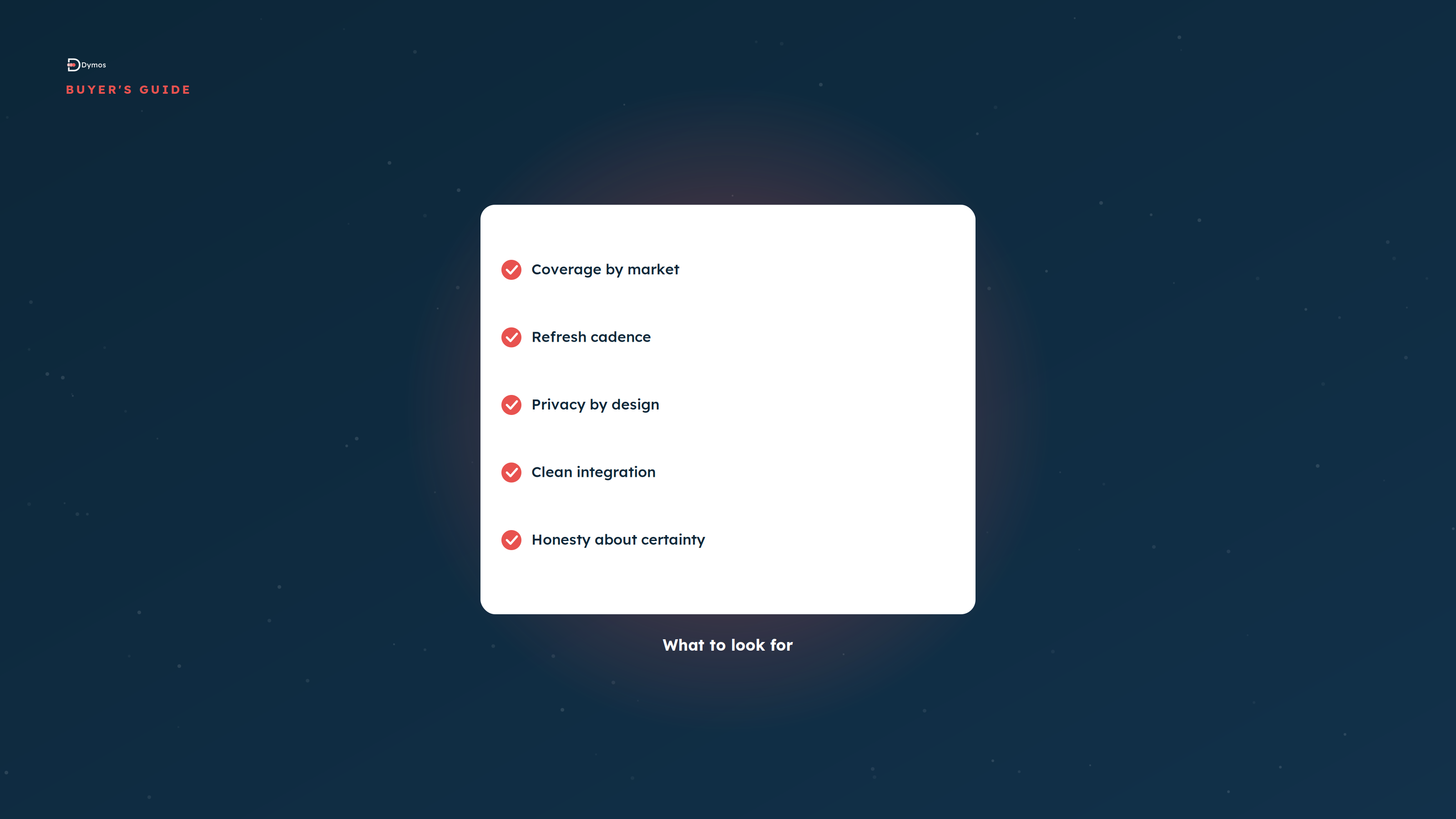
Coverage, by market and by hash type
A global average can hide weak individual markets. Ask for coverage broken down by the countries you care about, and, for identity, by hash type, since match rates vary across the common email hash formats. Consistent coverage across your markets from one source beats stitching together regional vendors with different definitions.
Freshness and refresh cadence
Connections and audiences drift as people change devices, providers and habits. Ask how often the data is refreshed and how that cadence is documented. A predictable, regular refresh keeps quality from eroding quietly between updates, and a partner that can show you the schedule is one that takes it seriously.
Privacy built into the architecture
There is a difference between a provider that manages privacy risk and one that avoids it by design. Look for a partner that works with pseudonymous signals rather than personal profiles, treats location as area and household context rather than individual tracking, and builds privacy into the architecture rather than bolting it on. Infrastructure built this way lowers your risk surface instead of adding to it.
Integration and fit
The best data is useless if it is hard to use. Ask how the partner's outputs load into the systems you already run, your DSP, CDP or data warehouse, and in the identifiers and formats your team already understands. A partner that enhances your existing stack rather than replacing it lets you prove value on one use case before you scale.
Honesty about certainty
This is the single most revealing criterion. Ask how each connection is made. Connections supported by strong, observed evidence are more dependable than those inferred through modeling, and a good partner distinguishes the two rather than presenting everything as equally certain. That honesty is exactly what lets you use the data well.
Questions to ask any partner
A short checklist pulls it together. Where does the underlying behavioral evidence come from? How does coverage break down by country and hash type? How is the data refreshed, and how is that documented? How is privacy built into the architecture? What does the connection actually let you do? And how do you handle the case where I bring my own graph? A partner that answers these plainly is one you can build on.
Bringing it together
The right identity and audience partner is not the one with the biggest numbers. It is the one that can show consistent coverage, a predictable refresh, privacy by design, clean integration, and honesty about certainty. Judge partners on what they can prove, not on what they claim.
Frequently asked questions
What should I look for in an identity resolution vendor?
Consistent coverage across your markets, a predictable refresh cadence, privacy built into the architecture, integration that fits your systems, and honesty about how certain each connection is.
How do I compare audience data partners?
Look past headline numbers to coverage by market and hash type, how the data is refreshed, how privacy is handled, and how connections are made. Ask each partner the same questions and compare the clarity of the answers.
How can I tell if a provider's connections are reliable?
Ask how each connection is made. Connections supported by strong, observed evidence are more dependable than those inferred through modeling, and a trustworthy partner distinguishes the two clearly.
Should I build or buy identity infrastructure?
Building in-house means solving coverage, refresh, privacy architecture and integration all at once. Many platforms buy it as infrastructure to offer the capability without expanding their own risk surface or data-engineering effort.
How important is privacy when choosing a partner?
Very. A partner that works with pseudonymous signals and builds privacy into the architecture lowers your risk surface, while one built on personal profiles becomes a liability you have to manage.