Reading time:
Last updated:
September 10, 2026
Choosing an Identity Data Provider: What to Consider
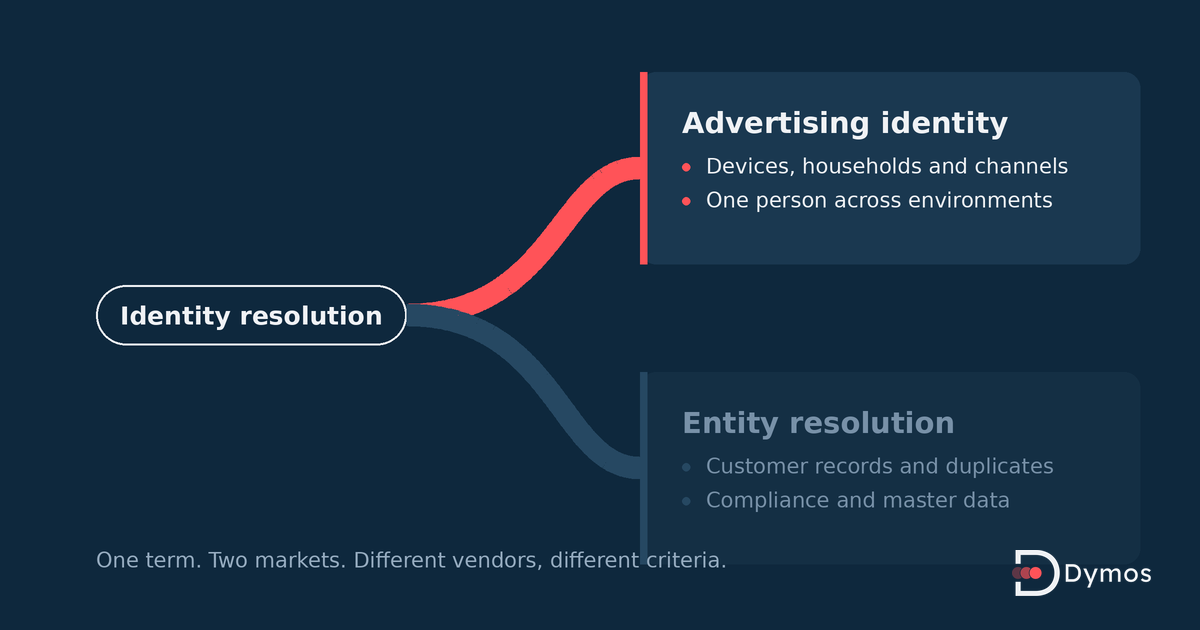
Searching for an identity data provider produces a confusing set of results, and the confusion is not the buyer's fault. The term covers two largely separate markets.
One is advertising identity, where the job is connecting devices, households, and channels so a campaign can reach the same person across environments. The other is enterprise entity resolution, where the job is reconciling customer records for compliance, servicing, and master data management. Both are described as identity resolution. They involve different vendors and different criteria.
This guide covers the considerations that tend to matter most when comparing options in the advertising category. It names no providers and ranks nothing.
START BY DEFINING THE JOB
Being specific about the requirement saves the most time.
If the goal is reaching the same household across mobile, desktop, and connected TV, the requirement is advertising identity. If the goal is recognising that several customer records describe one person, the requirement is entity resolution. If the goal is making a first-party file usable in advertising platforms, the requirement is onboarding, which sits between the two.
Clarifying this early narrows the field considerably, because vendors in each category can address the other category's questions well enough to reach a second conversation.
COVERAGE, VIEWED BY MARKET
Global coverage figures are difficult to act on when a media plan has a specific footprint.
Coverage broken out by the markets in the plan is more useful than an aggregate number, and it is worth clarifying what coverage means in each case. Devices observed once in a year and devices seen regularly in current traffic are different populations, and both can reasonably be described as coverage.
WHICH IDENTIFIERS ARE INVOLVED
The identifier types a provider works with shape which environments a campaign can reach.
Device identifiers map to mobile app and mobile web inventory. Household-level signals such as residential IP addresses extend reach toward connected TV and desktop, where a device identifier is not available. Hashed emails connect to logged-in environments and customer file matching, generally with narrower coverage.
A provider working with a single identifier type suits a single activation environment. That is often the right fit. It is worth establishing early either way.
HOW CONNECTIONS ARE ESTABLISHED
It helps to understand whether connections come from observed evidence, from probabilistic inference, or from a combination, and in roughly what proportion.
Both approaches are legitimate and they trade against each other. Observed connections tend to be more precise and cover less. Probabilistic connections extend reach and introduce some error. The useful thing is knowing which is being used where, so the result can be interpreted correctly rather than assumed.
REFRESH CADENCE
Refresh cadence is easy to overlook in a comparison and has a real effect on performance.
Identifiers change as devices are reset, replaced, and reassigned, so datasets refreshed weekly and quarterly describe different things even at identical size. It is also worth clarifying how often the underlying data updates rather than only how often a file is delivered, since those can differ.
MATCH RATE IN CONTEXT
Match rate depends on the identifier type, the destination platform, the market, and the traffic profile of the receiving system, which makes figures difficult to compare across providers.
The most informative approach is an overlap analysis against your own identifier pool, specifying the destination platform and the markets in the plan. That produces a number that applies to the actual situation rather than a general one.
PRIVACY AND LEGAL BASIS
The legal basis for collection and processing is worth documenting during evaluation rather than at contract stage.
For European activity that means a GDPR-compliant basis. Related questions include how consent signals travel with the data, how withdrawal is handled, and where data is processed and stored. These tend to take longer to resolve than technical questions, so starting them early is usually sensible.
DELIVERY AND COMMERCIAL MODEL
Practical details are worth confirming before contract: supported formats, destinations, schedule, and file schema, and whether data can be delivered into your own environment or is accessed through the provider's platform. The second point determines what can be built on top of it.
Pricing structures also behave differently at scale. Usage-based models and fixed data feeds can look similar during a pilot and diverge considerably as volume grows, so modelling both against expected year-two volume gives a clearer picture than a pilot alone.
HOW DYMOS APPROACHES THIS
Coverage is reported by market. Data is delivered in standard formats to the buyer's own storage or SFTP location, on a weekly cadence, so it sits in the buyer's environment. European data is processed on a GDPR-compliant basis.
These are the areas we are happy to talk through with any team running an evaluation.
Frequently asked questions
FREQUENTLY ASKED QUESTIONS
What is an identity data provider?In advertising, it is a company supplying connections between identifiers so a campaign can reach the same person or household across devices and channels. The same term is used in enterprise software for entity resolution, which is a separate market.
What is the difference between identity resolution and audience data?Identity resolution supplies the connections between identifiers. Audience data supplies the behavioural definition of who to reach. Some providers offer both, and they are assessed on different criteria.
What match rate should I expect?It varies with identifier type, destination platform, market, and traffic profile, which makes general benchmarks difficult to apply. An overlap analysis against your own pool gives a figure relevant to your situation.
What should I look at regarding privacy and compliance?The legal basis for collection and processing, how consent signals travel with the data, how withdrawal is handled, and where data is processed and stored. For European activity this should rest on a GDPR-compliant basis.
How long does an evaluation usually take?Technical questions are typically quick. Overlap analysis and legal review take longer, so beginning both early tends to keep timelines manageable.