Reading time:
Last updated:
September 16, 2026
Contextual targeting is having a long moment. The argument for it is familiar by now. Privacy regulation has tightened, signal loss has made cross-site profiles less reliable, and targeting the content rather than the person avoids the whole problem.
Much of that argument is sound. The part that tends to go unexamined is what it is being compared against.
Almost every piece written on contextual versus behavioural targeting assumes behavioural means third-party cookies and cross-site browsing profiles. That assumption is load-bearing, and it does not hold for every kind of audience data. Location-derived audiences are built on observed physical behaviour rather than on browsing histories, and they do not depend on cookies at all. Comparing them to contextual targeting produces a different and more useful conversation than the one the industry keeps having.
WHAT EACH APPROACH ACTUALLY TARGETS
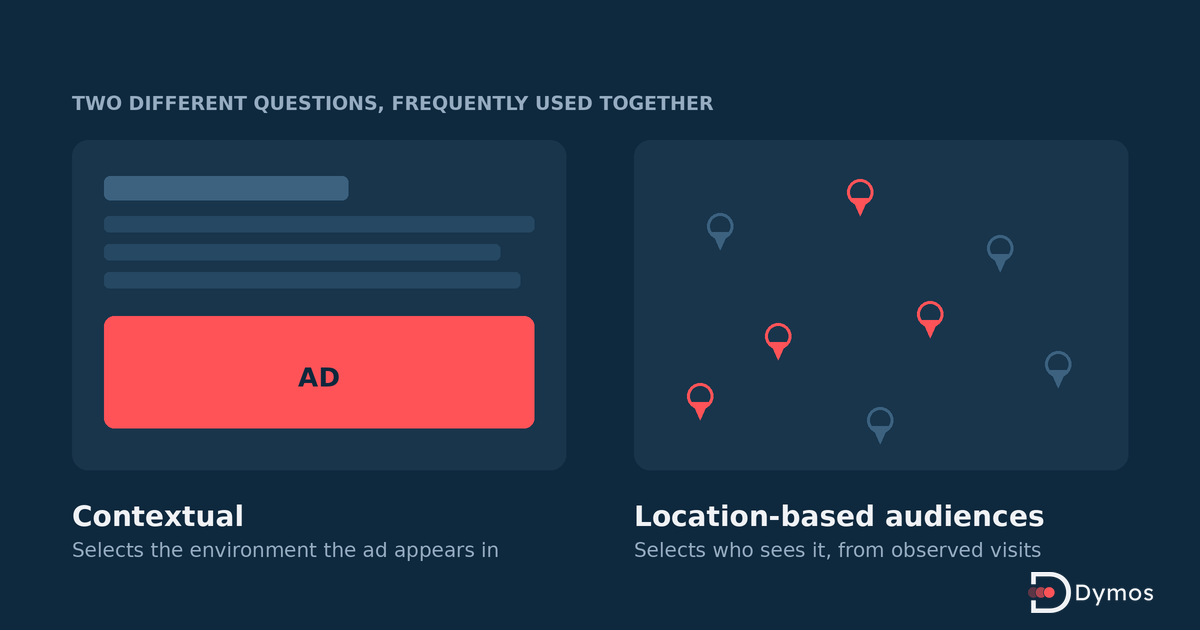
Contextual targeting selects the environment. It evaluates the page, the video, or the stream and places an advertisement where the content is relevant, without reference to who is consuming it. Modern implementations analyse page semantics, sentiment, and visual elements rather than simply matching keywords, which is a substantial improvement on the crude versions that gave the technique a poor reputation a decade ago.
Location-based audience targeting selects the person, or more precisely the device, based on observed physical behaviour. Someone who has visited particular retail locations, with a defined frequency, within a defined window.
These are answers to different questions. Contextual asks where a message should appear. Audience targeting asks who should see it. Treating them as competitors is a category error that persists mainly because vendors on each side have reason to frame it that way.
WHERE THE COOKIE ARGUMENT APPLIES AND WHERE IT DOES NOT
The strongest case for contextual targeting is durability. A strategy that depends on following users across websites is exposed to browser policy, to regulation, and to consent rates, and that exposure has only increased.
Google retired the remaining Privacy Sandbox APIs in October 2025 while leaving third-party cookies in Chrome, and Safari, Firefox, and Brave continue to block them by default. The result is a permanently mixed environment rather than a clean transition, which makes any single-signal strategy fragile.
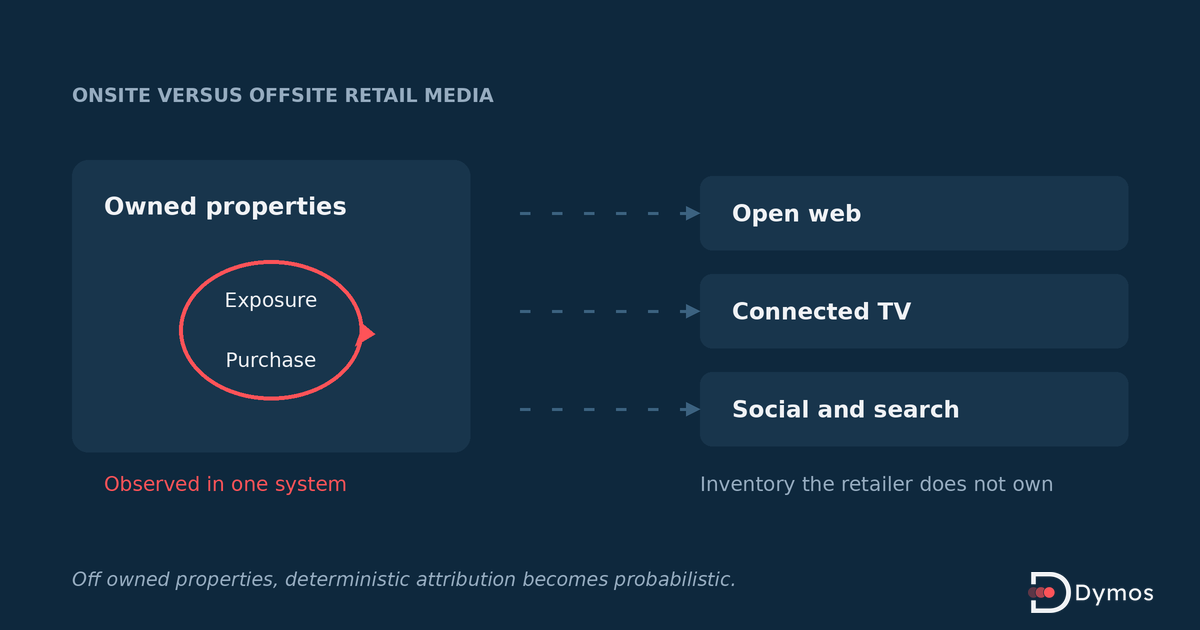
That argument lands squarely against cookie-based behavioural profiles. It lands differently against location-derived audiences, which are built from mobile advertising identifiers and observed presence rather than from browsing activity. Those segments have their own constraints, including identifier churn, consent requirements, and uneven coverage by market, but browser cookie policy is not among them.
So the durability question is worth asking of any data source, and the honest answer varies by source rather than by category.
WHAT THE EVIDENCE ACTUALLY SHOWS
Claims about contextual outperforming audience targeting should be read with attention to who produced them.
A study conducted with Playground XYZ and reported by WARC reviewed 76 campaigns across eight verticals and found contextually targeted placements delivered substantially more attention than benchmarks for skippable formats. That is genuine evidence for attention as a metric, in those verticals, under that methodology.
Market sizing figures are considerably less reliable. Published estimates of the contextual advertising market for 2026 range from roughly three hundred billion dollars upward, with projected growth rates between fourteen and twenty percent depending on the source, and most of these come from companies selling contextual inventory. The direction of travel is clear. The precision is not.
What independent commentary tends to converge on is complementarity rather than replacement. Comscore, which sells both, frames contextual and predictive audiences as complementary rather than competing. A common 2026 planning pattern places contextual and predictive targeting at the top of the funnel for privacy-safe prospecting, first-party and lookalike audiences in the middle, and retargeting at the bottom.
WHERE EACH ONE IS ACTUALLY STRONGER
Contextual is stronger when the message depends on the moment of consumption. An advertisement for running shoes alongside an article about marathon training works because of what the reader is doing right now, and no audience segment captures that timing as precisely.
It is also stronger for brand safety and suitability, since the environment is evaluated directly rather than inferred, and stronger at the top of the funnel where reach matters more than precision.
Location-based audiences are stronger when the behaviour that matters happens offline. Someone who has visited three competing car dealerships in a fortnight has demonstrated something no page they read can demonstrate. Physical presence is a stronger purchase signal than content consumption for any category with a physical footprint.
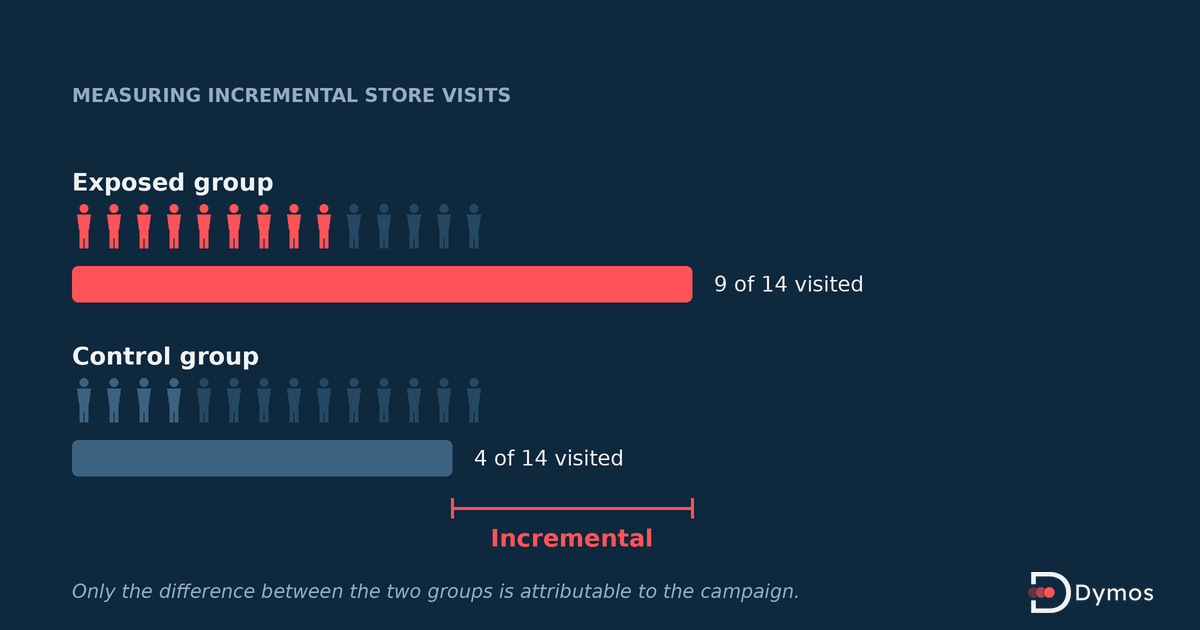
They are also what makes conquest, win-back, and catchment-area campaigns possible at all, and they connect naturally to store visit measurement, since the same observed behaviour that defines the audience can also indicate whether the campaign produced visits.
WHERE BOTH FALL SHORT
Contextual cannot distinguish between two people reading the same page, one of whom bought the product last week. It carries no memory, which makes frequency management and sequencing across a customer journey difficult.
Location-based audiences cannot describe intent that has not yet produced a physical action, they depend on identifier availability that varies by platform and market, and they say nothing about the environment an advertisement lands in.
Those weaknesses are close to complementary, which is the practical argument for using both.
HOW TO COMBINE THEM
The most common effective structure is to use contextual for prospecting and environment control, and audience data for precision and for anything further down the funnel.
Layering both on a single line item usually restricts delivery too far and produces scale problems, so separation by objective tends to work better than combination on one buy. Contextual carries reach and suitability. Audience segments carry the campaigns where knowing who matters more than knowing where.
For advertisers with physical locations, that split has a natural line. Contextual answers the question of where the brand should appear. Location-based audiences answer the question of who has already demonstrated they are in the market.
Frequently asked questions
FREQUENTLY ASKED QUESTIONS
What is the difference between contextual and audience targeting?Contextual targeting selects the environment an advertisement appears in, based on the content being consumed. Audience targeting selects who sees it, based on characteristics or observed behaviour. They answer different questions and are frequently used together.
Is contextual targeting better than audience targeting?Neither is generally better. Contextual is stronger where the moment of consumption matters, for brand suitability, and for privacy-safe prospecting. Audience targeting is stronger where the relevant behaviour is specific and has already occurred, particularly offline. Most 2026 planning frameworks use both at different funnel stages.
Does contextual targeting work without cookies?Yes. Contextual targeting evaluates content rather than the person, so it does not require cookies or cross-site profiles. This is the main argument made for its durability.
Are location-based audiences affected by cookie deprecation?Not directly. They are built from mobile advertising identifiers and observed physical presence rather than from browsing activity, so browser cookie policy does not apply to them. They have separate constraints, including identifier churn, consent requirements, and coverage that varies by market.
Can contextual and audience targeting be used together?Yes, though layering both on a single line item often restricts delivery too far. Separating them by objective, with contextual handling prospecting and environment control and audience data handling precision, generally works better than combining them on one buy.