Reading time:
Last updated:
September 16, 2026
Retail media worked because it was easy. A retailer had shoppers on its own site, knew what they bought, and could show them advertisements next to the products they were already searching for. Attribution was straightforward because exposure and purchase happened in the same place, and margin was high because there was no external media cost.
That model has run out of room. Onsite inventory is finite, and once it is sold out the only direction is outward. Offsite retail media spend is now projected to grow at roughly twice the rate of onsite through 2026, and a majority of the largest networks offer offsite capabilities.
The expansion is sensible and probably inevitable. It also breaks three things that made retail media attractive in the first place, and understanding which three is the difference between a well-planned offsite programme and an expensive one.
WHAT OFFSITE ACTUALLY MEANS
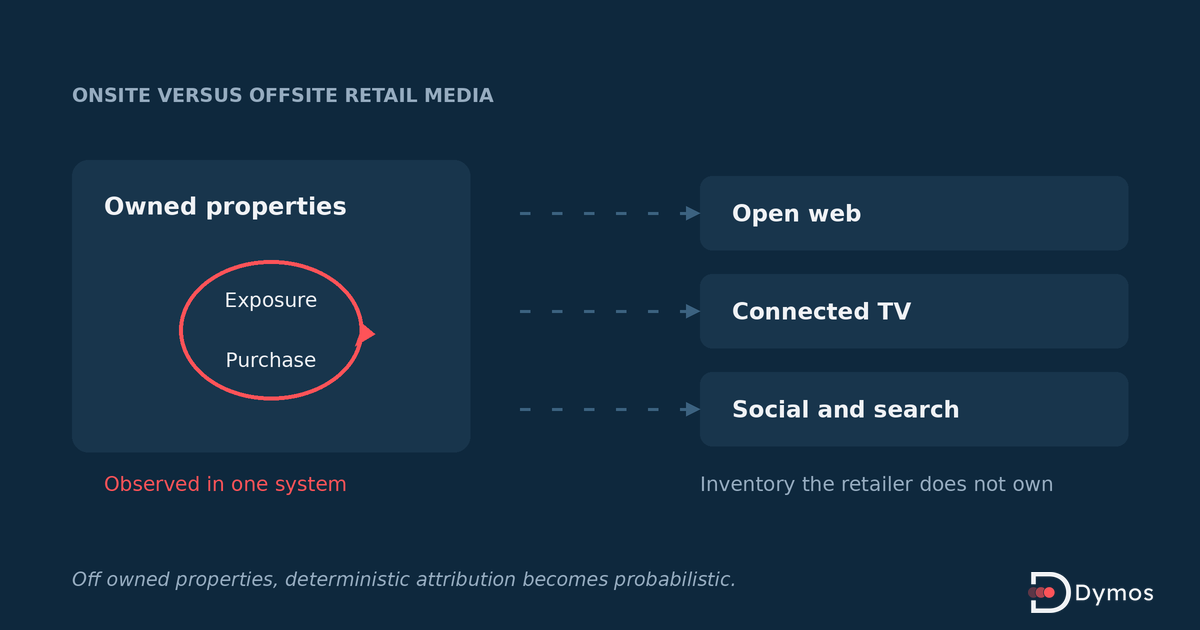
Offsite retail media uses a retailer's first-party shopper data to target advertisements on inventory the retailer does not own. Open web display, connected TV, social platforms, search, audio, and mobile apps.
The audience comes from the retailer. The inventory comes from somewhere else. That separation is the whole point, and it is also the source of every complication that follows.
Several large networks have built this in different ways. Some extend audiences through identity partners into external demand-side platforms. Some have acquired inventory outright, as with Walmart's purchase of Vizio, which gave it connected TV inventory subsequently opened to buyers through an external DSP. Others aggregate demand across many retailers rather than operating a single network.
THE FIRST THING THAT BREAKS: ATTRIBUTION
Onsite retail media offered closed-loop measurement that was close to deterministic. The same platform served the advertisement and recorded the purchase.
Offsite, that chain is broken. Exposure happens on inventory the retailer does not control, and the connection back to a purchase now depends on identity resolution rather than on observation within a single system. Deterministic attribution becomes probabilistic attribution, which is a different thing wearing the same name.
This matters more than it sounds, because the proof of performance was the main reason budgets moved to retail media at all. An offsite programme measured with the confidence of an onsite one is overstating what it knows, and the people most likely to notice are the brand teams whose budgets are being justified by it.
THE SECOND: MARGIN
Onsite inventory costs a retailer almost nothing to produce, so revenue from it is close to pure margin.
Offsite requires buying media on the open market. Real media cost enters the profit and loss, and the margin structure of the business changes with it. A retail media network that models its offsite economics on its onsite experience is likely to be disappointed.
THE THIRD: CONTROL
A retailer running advertisements on its own property controls the shopper experience completely. Offsite, it trades that control for reach it does not own, which introduces brand suitability questions that onsite never raised.
WHERE FIRST-PARTY DATA RUNS OUT
There is a fourth limitation, less discussed, and it is the one that matters most for audience strategy.
A retailer's first-party data describes its own shoppers doing their own shopping, primarily online. That is powerful and it is also narrow in two specific ways.
It does not describe people who shop the category elsewhere. A grocery retailer knows its own customers well and knows nothing about the shoppers of its competitors, who are precisely the audience a conquest campaign needs.
And it substantially under-describes physical shopping. Shoppers who rarely browse retailer websites but buy in store account for the large majority of packaged goods volume, and they are close to invisible in a dataset built from ecommerce behaviour. A retailer's first-party data is strongest for its online customers and weakest for the shoppers who generate most of the revenue.
WHERE THIRD-PARTY LOCATION DATA FITS
This is where external audience data has a genuine role rather than a pitched one, and it is worth being precise about which gaps it fills.
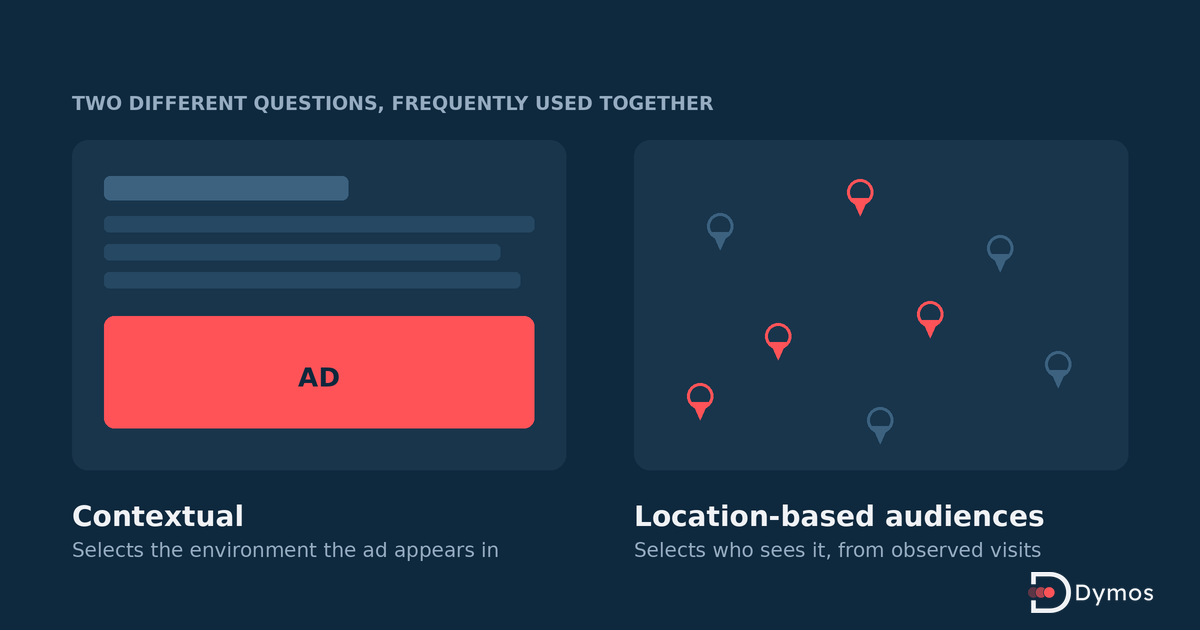
Category shoppers beyond a retailer's own base can be described through observed visits to competing and adjacent locations, which is what makes conquest and market expansion campaigns possible at all. First-party data cannot produce this by definition.
Physical shopping behaviour can be observed independently of whether someone has ever used a retailer's website or app, which addresses the in-store majority that ecommerce data misses.
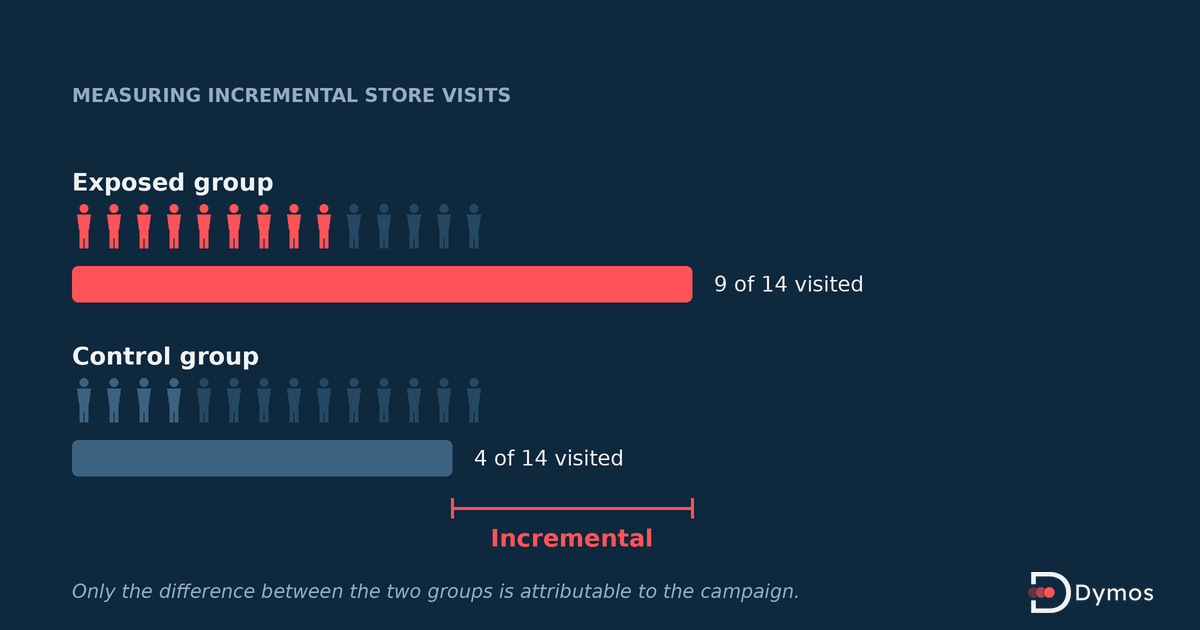
And store visit measurement offers a second measurement path for offsite campaigns. When the deterministic sales loop is broken by moving offsite, footfall-based measurement gives a directional read on whether the campaign produced physical visits, which is an imperfect substitute but a real one.
The honest framing is complementary. A retailer's first-party data is better than anything external for describing its own customers. External location data covers the people and the behaviour that first-party data structurally cannot see.
WHAT THIS MEANS FOR RETAILERS BUILDING A NETWORK
Three practical implications follow.
Model offsite economics separately rather than extending onsite assumptions, since the margin profile is genuinely different and the measurement is weaker.
Be explicit with brand partners about which measurement is deterministic and which is modelled. Networks that blur the distinction store up a credibility problem for the moment a brand's own analytics team examines it.
And treat audience extension as a data question before a media question. The reach constraint offsite is rarely inventory. It is how many of your shoppers can be recognised on inventory you do not own, which is a match rate question, and one worth answering before committing budget.
A NOTE ON MARKETS
Most published figures on retail media growth are drawn from the United States, where the market is larger and more consolidated. European retail media operates with different scale, different retailer structures, and a different regulatory context, particularly around the legal basis for using shopper data outside a retailer's own properties.
The structural arguments above apply in both. The numbers do not transfer.
Frequently asked questions
FREQUENTLY ASKED QUESTIONS
What is offsite retail media?It is the use of a retailer's first-party shopper data to target advertisements on inventory the retailer does not own, including open web display, connected TV, social platforms, search, and audio.
Why are retailers expanding offsite?Onsite inventory is finite, and once it is sold the only route to growth is outward. Offsite spend is projected to grow at roughly twice the rate of onsite through 2026.
Does offsite retail media still offer closed-loop measurement?Not in the same way. Onsite, exposure and purchase occur within one system, which makes attribution close to deterministic. Offsite, exposure happens on inventory the retailer does not control, so the connection to a purchase depends on identity resolution and becomes probabilistic.
What are the limits of retailer first-party data?It describes a retailer's own shoppers, mostly online. It cannot describe people who shop the category with competitors, and it substantially under-represents in-store shoppers who rarely use retailer websites, who account for the majority of packaged goods volume.
How does third-party location data complement retail media?It describes category shoppers beyond a retailer's own customer base, captures physical shopping behaviour independently of ecommerce activity, and offers a footfall-based measurement path for offsite campaigns where the deterministic sales loop no longer applies.