Reading time:
Last updated:
July 30, 2026
A campaign can look perfectly healthy in the dashboard — until it expands internationally.Audience segments match cleanly in the US, frequency caps hold, and targeting performs as expected. But the moment the same campaign runs in Europe or APAC, match rates drop, device IDs fail to resolve, and addressable reach quietly disappears.The problem is rarely the media strategy. In many cases, it sits deeper in the stack: the identity graph powering the campaign was never built with consistent global coverage.
The campaign that looked fine on paper
The brief was straightforward. A DSP running a cross-border campaign for a retail client needed consistent reach across North America, Western Europe, and Southeast Asia. The audience segments were built, the HEM-based targeting was activated, and the US results came back strong. Match rates held. Frequency caps worked. Performance looked healthy in the dashboard.
The problem was quieter than that. In Germany and France, the identity layer returned near-zero matches on mobile. In the APAC markets, the segments simply could not resolve to addressable device IDs at scale. The campaign spent budget on impressions that reached no one the client actually wanted to reach. And because the US numbers propped up the aggregate metrics, the data problem was never surfaced. It looked like a creative issue, or a bid strategy issue, or a market maturity issue. It was none of those things. It was a coverage gap baked into the identity infrastructure from the start.
This scenario is not rare. It plays out regularly across DSPs, CDPs, and identity providers that have built powerful targeting capabilities on top of identity graphs that were initially developed with stronger coverage in one primary market. The result is not a catastrophic failure. It is a slow and invisible drain on performance that is almost impossible to attribute correctly.
The real cost when identity stops at the border
Match rate collapse in international markets has a direct commercial consequence. For a DSP, it means bid requests go out without addressable identifiers, forcing either a fallback to contextual targeting or impressions served to audiences that cannot be tied back to known users or attributed reliably.
For a CDP, it means customer profiles enriched cleanly in one market arrive incomplete or unenriched in another, breaking the consistency that cross-market personalisation depends on.
Addressability in programmatic advertising depends heavily on match rates — the percentage of customer records that can be linked to identifiers inside an activation platform. When those match rates drop, targeting and measurement quality decline quickly.
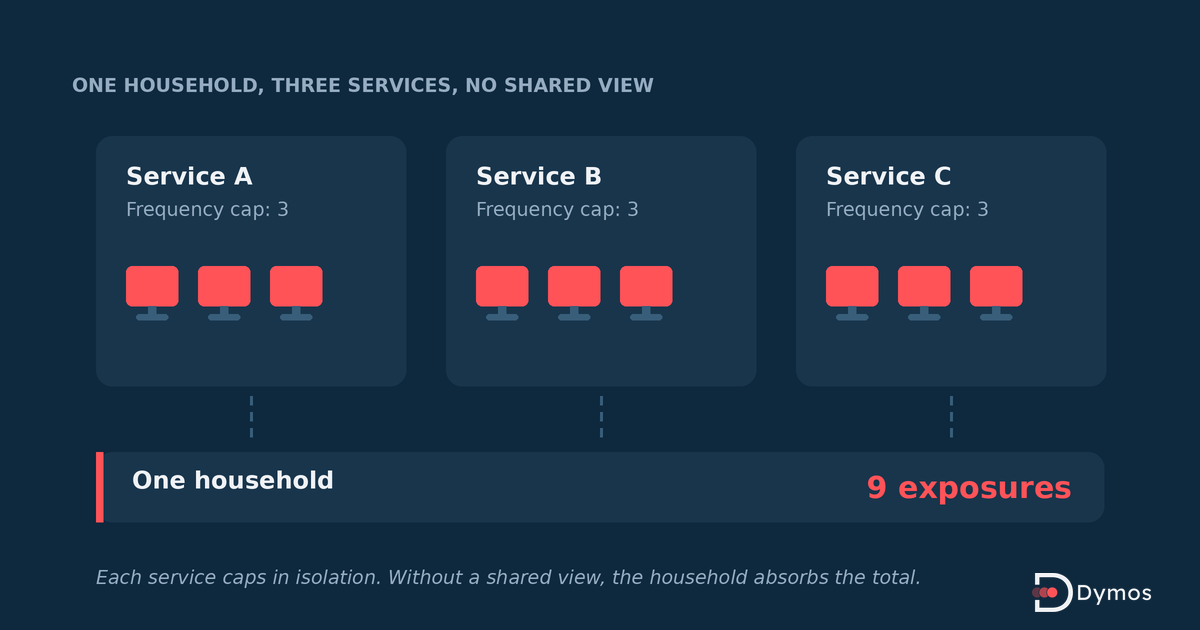
The downstream effects compound. Frequency capping can fail when the same user resolves to different identifiers across markets because the association that would normally link those identifiers does not exist in the graph. A household targeted on CTV in one country cannot always be connected to a mobile device in another. A retail media platform trying to suppress converted customers from paid acquisition campaigns may lose that suppression the moment the customer crosses a market boundary in the underlying identity data.
CTV advertising is particularly exposed. Many CTV targeting approaches rely on connecting devices through shared residential IP signals or other household identifiers. However, research has shown that inaccuracies in IP-to-household mapping can significantly reduce targeting reliability if the underlying identity layer is incomplete.
What consistent global coverage actually requires
Solving this problem is not simply a question of having more data. It is a question of having the right data, built consistently, across every market where a campaign might run.
That requires four things operating in parallel.
First, identity associations need to be built from observed signal in each market independently, not inferred solely from a proxy population in a different geography. A SHA256 hashed email linked to a GAID in Brazil, for example, should ideally come from device behavior observed in Brazil rather than from a model trained primarily on US patterns.
Second, the output format needs to be standardized across all markets so that a DSP or CDP does not need to implement different integration logic for each region it operates in.
Third, update cadences need to be consistent. A monthly refresh on HEM-to-MAID associations is useful only if that cadence holds in Germany as reliably as it does in the US.
Fourth, the processing methodology needs to be designed with regulatory environments such as GDPR in mind. Identity approaches that avoid storing precise location signals or raw device telemetry can reduce compliance risk and simplify deployment for clients operating in regulated markets such as the EU.
These are infrastructure requirements, not feature requests. And they are one reason why identity graphs can carry hidden coverage gaps even when their marketing materials describe global reach.
Frequently asked questions
Why do match rates drop in international markets?
Match rates often drop outside primary markets because identity graphs may have uneven coverage across regions. If fewer associations exist between identifiers like hashed emails, mobile advertising IDs, and IP signals in a given market, fewer users can be matched and activated.
What is a global identity graph?
Lorem ipsum dolor sit amet, consectetur adipiscing elit. Suspendisse eget ullamcorper ex. Donec scelerisque, urna a accumsan commodo, nisl diam facilisis enim, eget varius mauris metus eget massa. Vivamus molestie hendrerit dapibus. Duis convallis mi vitae est consectetur laoreet. Nulla nec nunc neque.
What is HEM-to-MAID matching?
Lorem ipsum dolor sit amet, consectetur adipiscing elit. Suspendisse eget ullamcorper ex. Donec scelerisque, urna a accumsan commodo, nisl diam facilisis enim, eget varius mauris metus eget massa. Vivamus molestie hendrerit dapibus. Duis convallis mi vitae est consectetur laoreet. Nulla nec nunc neque.
Why is global identity coverage important for programmatic advertising?
Lorem ipsum dolor sit amet, consectetur adipiscing elit. Suspendisse eget ullamcorper ex. Donec scelerisque, urna a accumsan commodo, nisl diam facilisis enim, eget varius mauris metus eget massa. Vivamus molestie hendrerit dapibus. Duis convallis mi vitae est consectetur laoreet. Nulla nec nunc neque.
How does MAID-to-IP data support CTV targeting?
Lorem ipsum dolor sit amet, consectetur adipiscing elit. Suspendisse eget ullamcorper ex. Donec scelerisque, urna a accumsan commodo, nisl diam facilisis enim, eget varius mauris metus eget massa. Vivamus molestie hendrerit dapibus. Duis convallis mi vitae est consectetur laoreet. Nulla nec nunc neque.