Reading time:
Last updated:
July 27, 2026
Why identity resolution matters now
Modern audiences move constantly. One person opens an email on a laptop in the morning, scrolls an app on the train, and watches connected TV at home in the evening. Each moment leaves behind a different identifier, and on their own, none of them reveals that they belong to the same person. This is the addressability problem at the center of digital advertising.
As third-party cookies fade and signal gets scarcer, that problem grows. Platforms still need scale, precision, and performance, but the identifiers that used to tie everything together are disappearing. Identity resolution is how the industry restores addressability without relying on cookies.
What identity resolution means
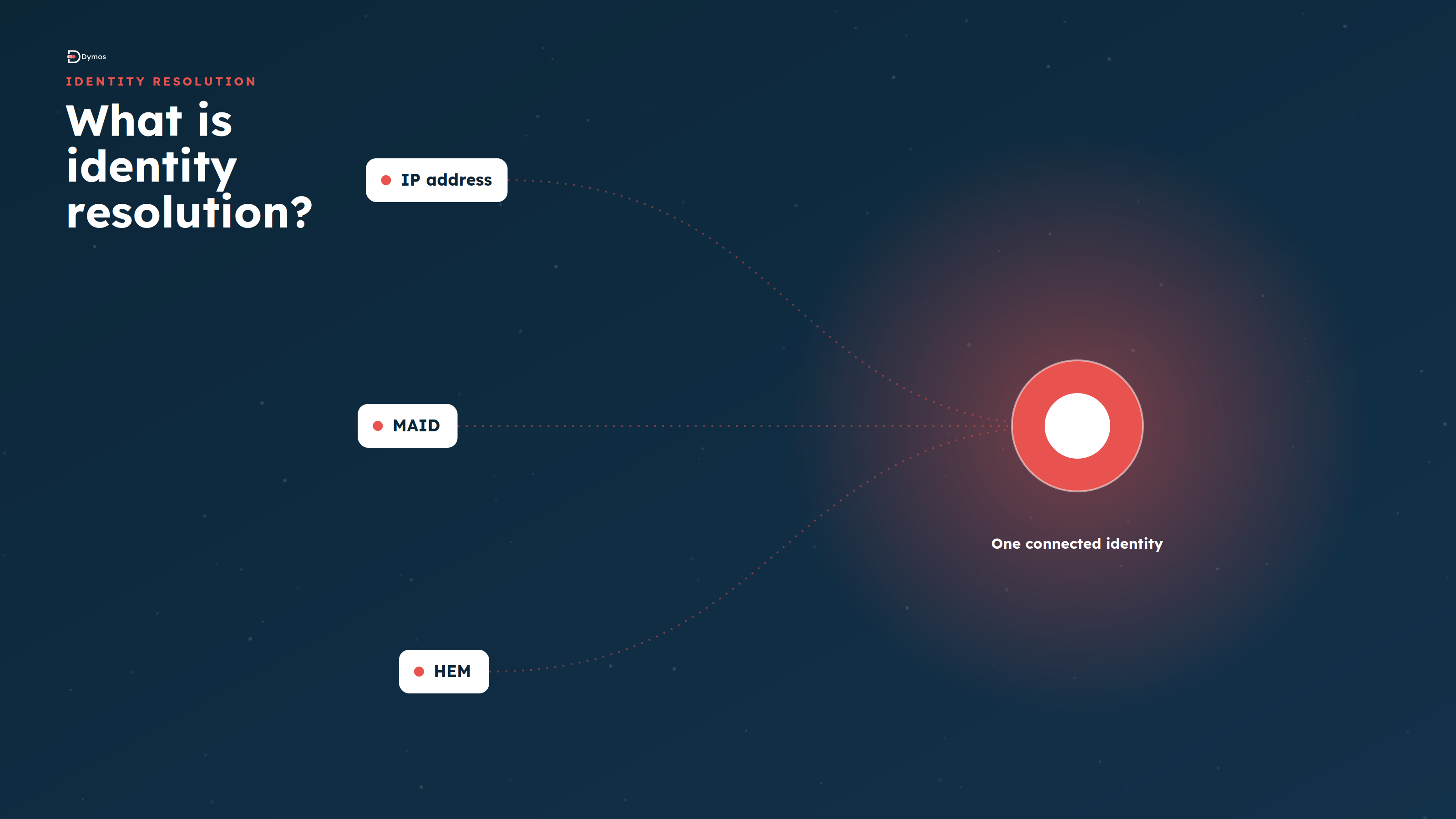
Identity resolution connects the scattered identifiers a person generates into one recognizable view. Instead of treating a hashed email, a mobile advertising ID, and a household IP address as three unrelated signals, it links them, so a platform can recognize the same audience across environments.
The important nuance is what the output is, and is not. Identity resolution does not produce a name or a personal profile. It produces a connected set of pseudonymous identifiers a platform can act on. The person stays anonymous. What becomes visible is the reach and the behavior, not the individual behind them.
Why fragmented identity costs revenue
When the same audience looks like a stranger on every channel, a platform is forced into a bad trade: go broad and waste budget, or go narrow and miss opportunities. The gap shows up in three concrete ways.
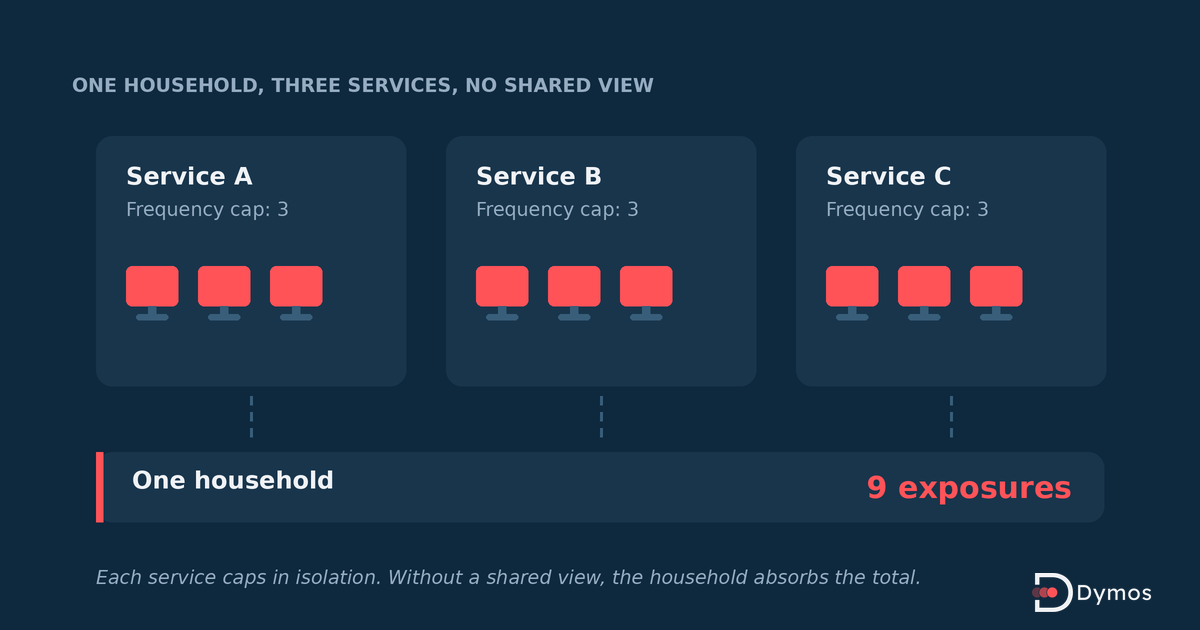
Frequency management breaks down, because a person who appears as three separate identifiers can be served the same message three times over. Reach gets double-counted, because one household counted as several unconnected devices inflates audience numbers and distorts planning. And performance analysis loses accuracy, because exposure on one screen cannot be connected to an outcome observed on another. Identity resolution closes that gap by reconnecting the signals into one audience.
How identity resolution works
Most identity resolution rests on a small number of core connections. Two do the heavy lifting in a privacy-first setup.
The first is email to mobile, often called HEM to MAID. A hashed email, which is a scrambled, non-reversible version of an email address, is connected to the mobile advertising ID on a person's device. This lets a platform recognize an email-based audience in mobile environments without ever handling the raw email.
The second is device to household, often called MAID to IP. A mobile device is connected to the residential IP address it consistently returns to, which anchors it to a household. This is what makes household-level reach possible for channels like connected TV, where the screen is shared and the device IDs inside the home are what a platform needs.
These connections are made where the evidence is strong enough to support them, and modeled more cautiously where direct signal is thinner. Good identity resolution is transparent about that difference rather than treating every association as equally certain. The connections are also refreshed on a regular cadence, because identity is dynamic: devices switch networks, households change providers, and associations evolve.
Identity resolution vs an identity graph
The two terms are often used interchangeably, but they are not quite the same. An identity graph is the underlying map of connections between identifiers. Identity resolution is the process of using that map to recognize an audience in a live situation. In short, the graph is the structure, and resolution is what you do with it.
What identity resolution enables
Once identifiers are resolved, the value is in what a platform can do with them. Identity resolution is infrastructure: it loads into existing systems and lets the platform activate, rather than doing the activation itself.
It enables cross-device activation, so an audience built in one environment can be reached in another. It supports CRM enrichment, connecting a company's own records to reachable identifiers. It makes household reach possible for connected TV. It underpins frequency management across channels. And it supports cross-channel attribution, connecting exposure on one screen to an outcome observed on another. In every case the platform stays in control of the campaign.
Identity resolution and privacy
Because identity resolution deals with people moving across devices, privacy is central. The distinction that matters is between connecting pseudonymous identifiers and exposing personal profiles.
A privacy-first approach works with pseudonymous signals, not names, contact details, or sensitive attributes. Hashed emails are non-reversible. Residential connections are treated as household-level context, not individual surveillance. The output tells a platform that an audience is reachable and how it behaves, not who it is. Framed this way, identity resolution restores addressability without becoming a personal-data liability, which is exactly why platforms increasingly treat it as infrastructure to rely on.
What to look for in an identity resolution partner
A few things separate a dependable partner from a risky one. Coverage should be consistent across the markets you operate in, so you are not stitching together regional providers. Refresh cadence matters, because stale connections quietly erode match rates. Privacy architecture should be built in from the start rather than bolted on. And integration should fit your existing systems, using formats and workflows your team already understands, so you can prove value quickly without rebuilding anything.
The strongest signal is honesty about certainty. A partner that distinguishes connections supported by strong evidence from those that are modeled is giving you the information you need to use the data well.
Frequently asked questions
Is identity resolution the same as an identity graph?
No. An identity graph is the underlying map of connections between identifiers. Identity resolution is the process of using that map to recognize an audience. The graph is the structure; resolution is what you do with it.
Does identity resolution identify individual people?
No. Privacy-first identity resolution works with pseudonymous identifiers, not names or personal profiles. It tells a platform that an audience is reachable and how it behaves, not who it is.
Does identity resolution work without third-party cookies?
Yes. It is built on connections between hashed emails, mobile IDs, and household IP addresses, none of which depend on third-party cookies.
What is HEM to MAID?
HEM to MAID is the connection between a hashed email address and a mobile advertising ID, which lets a platform recognize an email-based audience in mobile environments without handling the raw email.
How often should identity connections be refreshed?
Regularly. Identity is dynamic, so connections that are not refreshed on a predictable cadence drift out of date and quietly lower match rates.