Reading time:
Last updated:
September 10, 2026
Why Audience Match Rates Drop Between Provider and Platform
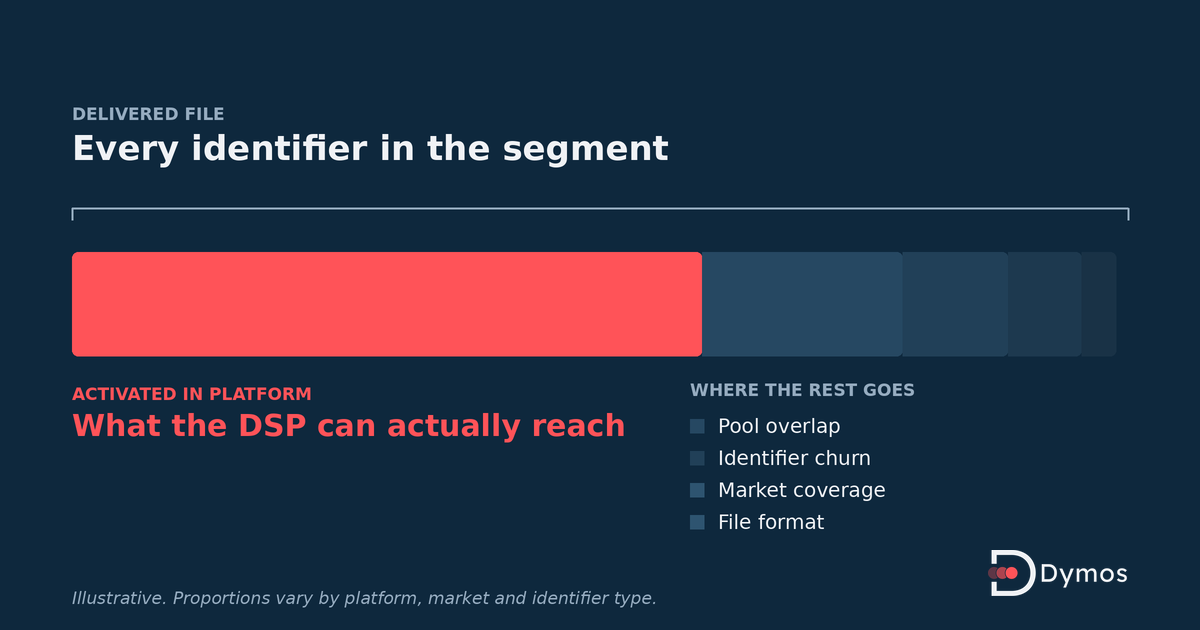
A file arrives with ten million identifiers. The campaign activates against six million. Nobody warned anyone this would happen, and now a media plan built on the first number has to be rebuilt around the second.
This is the most common unpleasant surprise in third-party audience buying, and it is entirely predictable. The gap between a delivered file and an activated audience has a small number of specific causes, none of them mysterious. Understanding them turns match rate from a post-campaign disappointment into a question you settle before signing.
WHAT MATCH RATE ACTUALLY MEASURES
Match rate is the share of identifiers in a delivered file that a receiving platform can recognise and use.
That definition contains an important detail. Match rate is not a property of the file. It is a property of the relationship between two specific systems, so the same segment will produce different match rates in different platforms, in different markets, and in the same platform six months apart. A provider quoting a single match rate figure without reference to a destination is quoting something that cannot be true in general.
OVERLAP IS THE LARGEST FACTOR
A provider's identifier pool and a platform's live traffic are two different populations. The segment only functions where they intersect.
Neither system is at fault when the intersection is smaller than either party would like. A data provider observes behaviour in the environments its sources cover. A platform sees the traffic its supply relationships deliver. Those two footprints overlap substantially but never completely, and the size of the overlap is set by which apps, sites, and inventory sources sit on each side.
This is why the only meaningful pre-contract measurement is an overlap analysis against your own pool rather than a global audience count. A provider willing to run one is telling you they expect the answer to be acceptable. A provider who deflects to total audience size is answering a different question.
RECENCY AND IDENTIFIER CHURN
Identifiers do not last. Devices are reset, replaced, sold, and reassigned, and a mobile advertising ID observed months ago may no longer appear in live traffic at all.
The consequence is counterintuitive for anyone evaluating on size. Extending a lookback window from thirty days to ninety inflates the file and lowers the proportion of it that activates. The segment gets bigger and less useful at the same time, and only the first of those two effects appears in a proposal.
Refresh cadence works the same way from the other direction. A weekly refresh describes behaviour that is still current. A quarterly one is increasingly a historical record, and the share of it that a platform still recognises falls with every week that passes.
THE ENVIRONMENT IS MORE FRAGMENTED THAN THE INDUSTRY EXPECTED
For six years the industry planned around a single transition. Chrome would remove third-party cookies, Privacy Sandbox would replace them, and everyone would migrate together.
Neither half happened. Google abandoned cookie deprecation, and in October 2025 it retired the remaining Privacy Sandbox APIs, including Topics, Protected Audience, and Attribution Reporting, with removal from Chrome scheduled through mid-2026. Third-party cookies remain in Chrome with no removal timeline. Meanwhile Safari, Firefox, and Brave continue to block them by default, which leaves a meaningful share of global traffic without them regardless of what Chrome does.
The result is not a clean before and after but a permanently mixed environment. No single identifier type works everywhere, which means a file built around one identifier will match well in some environments and poorly in others. Files that pair a device identifier with a household-level signal such as a residential IP address tend to activate across more surfaces, because they give the receiving platform more than one way to make a connection.
MARKET AVAILABILITY AND LEGAL BASIS
Coverage is never uniform across countries, and a globally sized audience will not activate evenly.
A provider strong in North America may be thin in the specific European markets a campaign actually buys. Availability also depends on the legal basis for processing the underlying data, which differs by jurisdiction, and for European activity should be documented on a GDPR-compliant basis in writing rather than asserted in a meeting.
The practical step is to ask for coverage by market rather than in aggregate, and to compare it against your own media plan rather than against the provider's strongest region.
FILE HYGIENE, THE AVOIDABLE ONE
A smaller share of loss is purely mechanical and entirely fixable. Inconsistent casing, mixed identifier types in a single column, unstable schemas between deliveries, and hashing applied differently on each side all cost match rate for no analytical reason.
This category is worth checking first when a segment underperforms without explanation, because it is the only cause on this list that can be fixed in an afternoon.
WHY THERE IS NO BENCHMARK WORTH QUOTING
Buyers frequently ask what a good match rate looks like. There is no defensible general answer, and the figures circulating in the market should be treated carefully.
Most published match rate numbers come from companies selling identity resolution or onboarding services, measured on their own data, against destinations they chose, in markets that suit them. That does not make them false, but it does make them unsuitable as a benchmark for a different file going to a different platform in a different country.
The useful substitute is comparative rather than absolute. Measure two providers against the same pool, the same destination, and the same market, and the comparison means something even though neither number generalises.
HOW TO SETTLE IT BEFORE YOU SIGN
Ask for an overlap analysis against your own identifier pool, specifying the destination platform and the markets you actually buy.
Ask which identifier types the file contains, since that determines which environments the segment can reach. Ask what the refresh cadence is and whether the lookback window can be configured, because both directly move the number. Ask for coverage broken out by market. And agree the file specification, including format and schema, before the first delivery rather than after the first disappointing campaign.
At Dymos, audience segments are delivered on a weekly cadence in standard formats to your own storage or SFTP location, with coverage reported by market, and overlap analysis available before any commitment.
Frequently asked questions
FREQUENTLY ASKED QUESTIONS
What is an audience match rate?It is the proportion of identifiers in a delivered audience file that the receiving platform can recognise and use in live traffic. It describes the relationship between two specific systems rather than a fixed property of the file.
What is a good match rate?There is no reliable general benchmark, because the figure depends on the identifier type, the destination platform, the market, and the platform's own traffic profile. Published figures usually come from vendors measuring their own data against destinations they selected. Comparing two providers against the same pool and destination is more informative than any absolute number.
Why is the activated audience smaller than the file?Chiefly because the provider's identifier pool and the platform's live traffic are different populations that only partly overlap. Behavioural recency, identifier churn, uneven market coverage, and file formatting account for the rest.
Does a longer lookback window help?It increases file size and usually reduces the share that activates, because older identifiers are less likely to appear in live traffic. The tightest window that still delivers the scale you need is generally the right one.
How can I measure match rate before signing a contract?Request an overlap analysis against your own identifier pool, specifying the destination platform and the markets in your media plan. A provider who will run one before a contract is giving you the only figure that applies to your situation.